
MODEPOT · EXPERIMENTAL ALPHA
A custom embedded database for Python.
RefPot is an experimental alpha: a native C++ redo-and-checkpoint engine with a small Python CRUD and explicit-transaction interface. Check PyPI for the latest published version; qualification remains limited.
INSTALL FROM PYPI
Try the experimental alpha
python -m pip install refpotQuick start guide A first database
Section titled “A first database”Install RefPot with python -m pip install refpot, then save this complete program as first_database.py:
from pathlib import Pathfrom tempfile import TemporaryDirectoryfrom refpot import Database, Row
with TemporaryDirectory() as directory:    path = Path(directory) / "notes.rp"    with Database(path) as db:        db.insert(1, 42, "answer")        db.update(1, value=43)        assert db.get(1) == Row(1, 43, "answer")
with Database(path) as db: assert db.get(1) == Row(1, 43, "answer")python first_database.pyThis is executable package behavior, not a site simulation. See the quick start, CRUD, transactions, persistence, and errors and ownership guides.
Current package implementation
Section titled “Current package implementation”This diagram shows the current experimental alpha package implementation. Package and platform qualification remain limited.

Run the shipped CRUD and transaction examples
Section titled “Run the shipped CRUD and transaction examples”The preview supports caller-provided signed-64-bit integer keys and values, UTF-8 text up to 31 encoded bytes, CRUD, and explicit transactions. The parent directory of a database file must already exist. Build prerequisites, ownership, recovery behavior, errors, and limits are in the package contract.
From a checkout with a C++17 toolchain, run the literal install and shipped examples:
uv pip install .python examples/crud.pypython examples/transactions.pyThe examples use temporary files, exercise inserts/updates/deletes and commit/rollback, then reopen persisted state. They run the native package; this site does not simulate database execution. The example sources are the executable reference.
Package contract and qualification
Section titled “Package contract and qualification”A database is exclusively owned by one process and usable only by its creating thread. Snapshot and WAL recovery are bounded to 64 MiB each. Incomplete unacknowledged tails are discarded; complete transactions with both copies corrupt are rejected; uncertain writes poison the writer. These implementation details do not establish broad recovery or physical power-loss qualification. SQL, ORM, concurrent readers, multiwriter operation, Windows, and existing-format compatibility are not supported.
The six-cell actual-package screen compares public Python calls with prepared SQLite. Three cells remain below 2×, so the overall SQLite target remains unmet. Provenance identifies source revisions represented by wheels labeled 0.1.1; these are not measurements of package artifacts built from 0.1.2 metadata. See the full package results and the reproduction guide. Historical update-harness ratios and reopen losses remain separate evidence.
Read the exact package contract, status and next steps, design direction, performance qualification method, and canonical roadmap. SQL and ORM are design direction, not shipped functionality.
Historical benchmark findings
Section titled “Historical benchmark findings”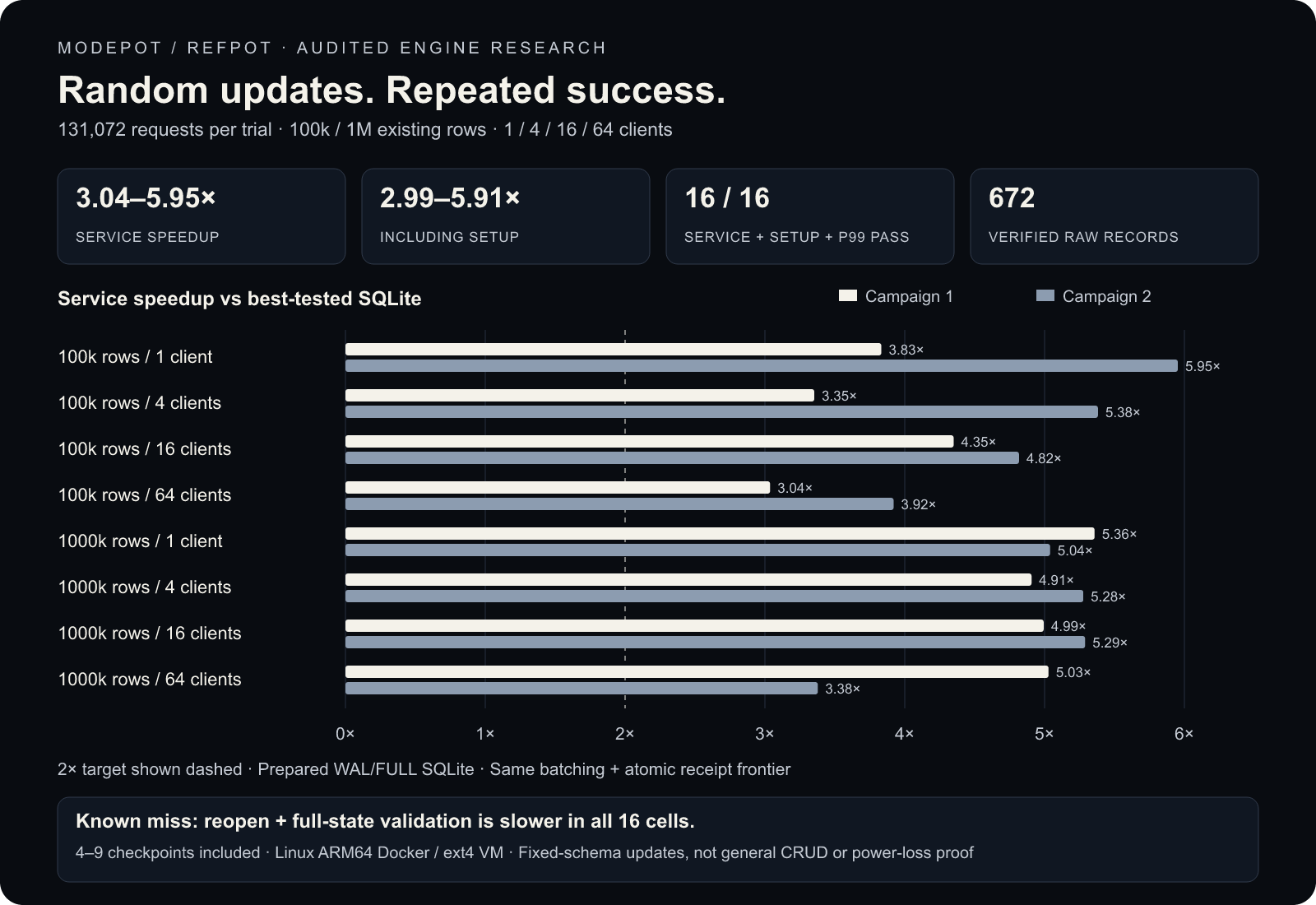
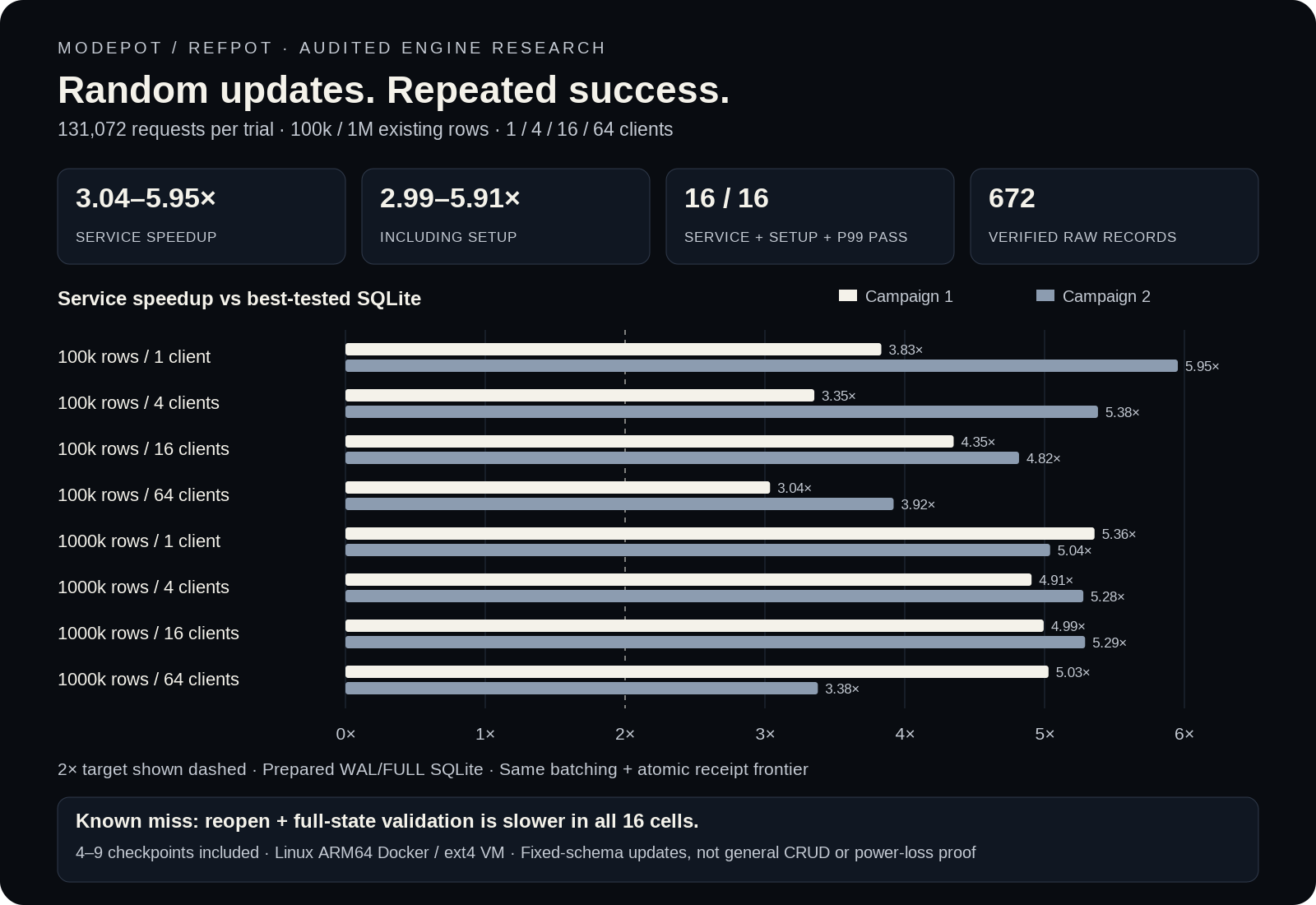
The 3.04–5.95× service and 2.99–5.91× setup-inclusive results apply only to the historical existing-row update harness in a Linux ARM64 Docker/ext4 VM. This is not a package claim. The experiment retained 672 records across two campaigns; reopen with full-state validation remains 16/16 losses, and earlier failed experiments are preserved. Package performance is unqualified; the broad 2×-over-SQLite objective remains an acceptance target.
Read the accessible per-cell results and audit before citing a ratio. The performance qualification method explains what a future package comparison must establish.
Contribute and use agent guidance
Section titled “Contribute and use agent guidance”The contributor guide covers native development setup, test/build commands, changelog fragments and the release boundary. The coding-agent guide documents public API limits, repeatable examples and uncertain-write handling; installing RefPot does not automatically install that skill. Join the ModePot community for discussion or use GitHub Issues for scoped proposals and reproducible findings. RefPot is MIT licensed.
Planned architecture — not shipped
Section titled “Planned architecture — not shipped”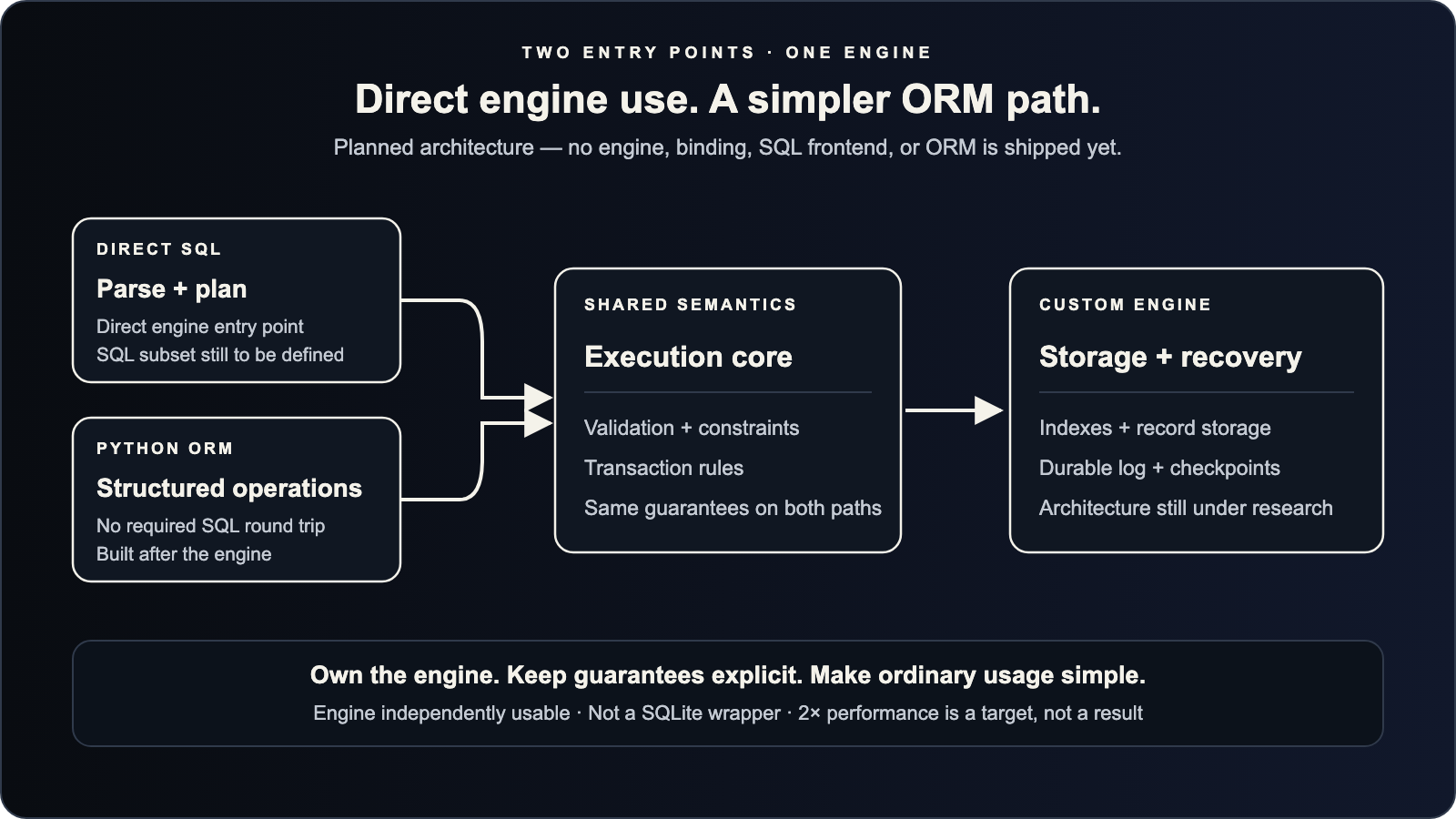
Next — Quick start
Section titled “Next — Quick start”Continue to the package quick start and source-build instructions, then browse the shipped examples on GitHub.